Showing posts with label learning resources. Show all posts

Monday, November 30, 2015

Patreon Project Kit for Artists


EDIT 2: As of 10/25/2017, Patreon has added Apps to help automate certain tasks, such as Patron-only posts for Wordpress and adding Patrons to your mailing list with Mailchimp. Check the apps out here! I'll post my thoughts on them after I've had a chance to experiment with them.

EDIT: Patreon has started a referral program! So if you'd like to give it a try, feel free to use my referral link - https://patreon.com/invite/gpvq


I'm a firm believer that crowd-funding is the wave of the future and the core building block of a growing breed of artist-entrepreneurs.  As soon as Patreon launched back in 2013, I knew they'd be something special for the creative community!  Through this format, people have been able to share more directly than ever before.

I thought I'd join in that spirit of giving by sharing the structure, templates, and other resources that keep my Patreon ticking!  I hope it helps other artists out there considering promoting their projects via this site.  Let's make a Patreon!

Release Schedule

When you set up your account, it's important to have an idea of how and when your releases will occur and also other notices you'd like to send to your Patrons so you can be aware of how much you might be spamming them at once so they don't get fatigued by your posts. Mine go something like this:

Last Day of the Month.  Patreon begins charging your Patrons on the 1st of the month, so let's start there!  The monthly image is uploaded before or on the last day of the month. I only release one painting per month to keep things simple, but you may want to release more frequently!

EDIT 11/20/2025: I eventually moved to charging once per month for any updates rather than Per Creation, as this way Patrons won't be surprised by any charges if I happened to be especially productive in any given month.  Patrons gave me feedback that this was easier for them to budget.

Within the First Week of the Month.  Rewards for all levels are posted in individual posts (one for each tier) and a PM is sent out regarding my Keyword Inspiration sketch (an event I hold monthly for $5+ Patrons where they turn in prompts and I draw the most inspiring prompt).  (You can also use Patreon's Shop area to host rewards, as you can make shop items free for individual tiers.)

The 15th of Every Month.  A mid-month reminder post reminding people to attend my monthly Studio Hangout (with a link to the Event on Google+), sharing a WiP of that month's art, and any other important reminders that might be relevant. The 15th is also my internal deadline to have the physical Rewards mailed out. (EDIT: I have since moved to letting Patreon Merch fulfill on my behalf and this has made my life easier! Very much worth the extra cost of the program.)

- Last Wednesday of Every Month.  A link to the recording of my live Studio Hangout is posted to Patreon.  The recording is auto-generated by Hangouts and posted to YouTube for me, which makes things easy.

(EDIT 11/20/2025: Lately, I use Twitch to broadcast hangouts and take recordings with Streamlabs.)

Digital File Rewards


Digital Rewards are the cornerstone of any Patreon since they're easy to fulfill and require less of an expense on the artist's part. Here are a few ideas for distributing digital items.

- EDIT 11/20/2025 Patreon's Shop.  Patreon natively hosts shop listings now which you can offer free to specific tiers, making it great storage for digital rewards.

- Patreon File Attachments. Now that Patreon supports post tags, Rewards are easy to find and autotagged by the cost of the Rewards level without you needing to lift a finger.  You could also create tags with custom Rewards names, if you've personalized your tier titles.  Be aware that a single post can support unlimited attachments as long as each attachment is not larger than 200MB.

- Gumroad.  Gumroad is a free online shop service that allows a user to create shop listings and host digital files of up to 16GB per attachment.  They allow users to create private listings, which is perfect for sharing Patreon exclusive files.  You can also share files that would usually cost money by creating a special offer code and sharing links where the code is auto-applied to your listing only with your Patreon Patrons.  Best of all, Gumroad takes care of the file hosting and link management for your Patrons!  You can find out more about using Gumroad the way that I am suggesting here and here (the 2nd method discussed on the help entry about creating an offer to make a product free is the one I'm referring to).

- DeviantART's Sta.sh. DA's sta.sh allows for private viewing of file links for anonymous viewers who have the url. You can store any kind of file (image, video, etc.) and also 'stack' them if you have multiple releases you'd like to show at a single url. The current default limit for free users of DA is 2GB while Premium members get 10GB. Another random perk is that you can also hotlink to sta.sh files if you are embedding images into html on other sites.

- YouTube. YouTube allows you to upload videos at private links (called 'unlisted videos') that are only accessible to those who have the link.  It's a good alternative if you want to offer a streaming option for videos instead of requiring a complete download of the entire file.

Private Journal Entries


Sharing exclusive posts can really make Patrons feel special! However, Patreon's current journal function is very limited and doesn't allow images and text to be formatted easily. For this reason, here are some suggestions for ways to share private journals:

WP Hide Post. If you run a site built with Wordpress, the WP Hide Post plugin allows you to completely hide a post from search engines, your website's categorization, etc. so that you can essentially host a private post on your server that you can link people to.  Only those with the direct link can see it or find it.

- DeviantART's Sta.sh. While also useful for storing files, you can also use Sta.sh Writer to create more robust journal entries than Patreon currently does that can be linked to directly, but not accessed publicly. These private journals also allow DeviantART users to comment on them.

- EDIT: 5/17/2023 Patreon's Wordpress Plugin.  This plugin for Wordpress will let you lock posts behind a paywall organized by your Patreon's tiers on your Wordpress site so that you can encourage promotion natively from your own website.  You can see this in action on my website here.

Physical Rewards


- Postcard and Greeting Card Mailings. I use www.postable.com for a fast, secure, and easy solution for mailing out postcards (ie. Christmas cards, Thank You cards, etc.) to my Patrons. You can personalize your cards online, though they will not be handwritten.

- Prints. I usually print off my own prints via an Epson Artisan 1430 which boasts lightfast inks and wide format printing (up to 13x19 inches), but when I need bigger and/or fancier prints (ie. giclee, canvas, mounted prints, etc.), I turn to www.iprintfromhome.com (tell them Angela Sasser sent you and we both get Thank You dollars when you make your first order!).

- EDIT: 5/17/2023 Patreon Merch.  I've recently joined the Merch program to test it out and I'm very excited!  I know the quality will be good, as they have integrated with Printful, which I already use in my shop for drop-shipping.  This program promises to save me time by managing all my merch packaging, delivery, and loyalty tracking needs.  Once I have tried this program for awhile, I'll be sure to share a full review here.

Reader Suggestions

Before I get to the Templates, I'd love to hear your reader suggestions in comments!
If you have any tips or resources you'd like to add that I find particularly helpful,
I'll add your tip to this journal entry with a link to your Patreon page.
Let's make this entry a great resource for the community!

Templates

Patreon has an official set of logos, wordmarks, and swatches you can find here!  They have specific rules of how they prefer their logos to be used, so it's definitely worth checking out this page.

Sunday, April 13, 2014

FIRST IMPRESSION: Proko's Figure Drawing Fundamentals Course NSFW

I've been a huge fan of ProkoTV's figure drawing videos on YouTube ever since I first watched his amazingly helpful "Draw a Head at Any Angle" tutorial, which I still look back on for reference to this day!

For those who don't know him, ProkoTV is hosted by artist, Stan Prokopenko, a talented figurative artist who teaches at the Watts Atelier of the Arts.

I enjoy the way Stan's videos appeal to my visually-minded nature with comparative examples and his very lighthearted and entertaining teaching style.  Rather than focus on the science of anatomy, his videos teach how to break the body down into simple shapes and emphasize expression over 'correctness'.  If you've read Michael Hampton's Figure Drawing: Design and Invention, Stan's methods are very similar.

Lately, all of my portfolio reviewers have pointed to the same thing that keeps holding my work back - anatomy.  Sure, I know how to draw a human figure, for the most part.  But my anatomy is missing that special something, that secret ingredient!

I notice that when I start adding detail, some of the energy and life drains right out of my figures.  My rendition of the joints of the figure also lack definition and understanding, leaving my figures feeling too smooth and ultimately unconvincing.

You might be asking why would someone who's not a beginner want to purchase a 'fundamentals' course?  Now, I've read and looked at many an anatomy book in my day in college and for my own study, but I find that I just can't remember anatomy.  No amount of drawing the skeleton and muscles and labeling the parts really helps me retain how to draw the figure.

My brain needs spatial geometric understanding and hands on training (being the kinesthestic learner that I am), which makes the structure of Proko's course appealing with its simplistic approach and many, many extra examples for tactile learners like me.  Also, as an artist, I am never done learning.  There is too much to know about anatomy to ever be done learning!

And so it was I decided to invest in Stan's Figure Drawing Fundamentals course for $79, including two pose photo packs (one male and one female) at $10 a piece (spending a total of $100).  These packs are a great value considering they include 300 poses in each one.  The poses are very well-lit and professionally photographed.  Once purchased, the pose pack download page includes a convenient link for you to download your choice of a .zip containing high res or lower res versions of the photos, for those of us studying with tablets which benefit from smaller file sizes.


Though Stan offers his figure drawing videos for free on YouTube, his course includes the longer premium content versions of his lessons.  For example, his first lesson on gesture is only 9 minutes for the free version, while the premium content version is 27 minutes.

Here's a look at the download page for just ONE of the lessons (of which you an view the full lesson list here).  I am impressed by the sheer amount of demos available to help students wrap their brain around how to apply the technique to various poses.


Also included are critiques of student homework, which is useful for learning not only what is correct, but what is incorrect along with the common mistakes that most people make in their figure drawing techniques.  As icing on the cake, Proko also brings in other experts, such as Marshall Vandruff and Glenn Vilpuu.

Under each video is a download link, allowing you to store the videos for your own reference or carry them with you for study on the go.  This is priceless and encourages me to invest knowing that even if for some terrible reason Stan's site goes down that I will still have access to my lessons.  Once you pay for premium content, you are granted unlimited access to your poses and lessons for the foreseeable future.

I've only just started this course and am looking forward to seeing how this affects my work!  I'll be sharing my progress and studies here with you, as well as a follow-up review of the overall course when I am finished with it.  So far, I am very impressed by the thought and care put into providing such well-priced and detailed learning resources for artists and I expect to learn a lot from this course!

Till then, go watch some ProkoTV and tell me what you think!

Wednesday, February 22, 2012

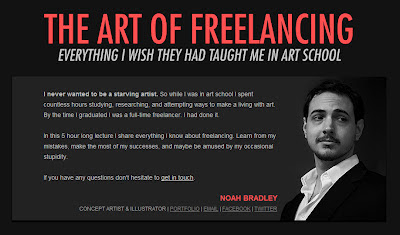
REVIEW: Noah Bradley's The Art of Freelancing

During random  internet exploration of the fabulous critique site, WiPNation, I stumbled across a blog post featuring an article about Noah Bradley's Art of Freelancing.  I was instantly intrigued by the prospect of learning 'what the art schools didn't teach' and decided to give Noah's video a try after seeing a positive review at ArtOrder and listening to the free preview of the first 30 minutes posted on the site.


I was sold in that first 30 minutes with Noah's very up front approach to the hard truths of what freelancing really is.  It is oftentimes hard work, sleepless nights, and low pay, but most importantly one CAN make a living as a freelancer, if one is persistent!  Noah addresses commonly asked questions from novice freelancers, including but not limited to:

- How much do I charge?
- Where do I look for clients?
- What's in a contract?
- Where do I look for work?
- How does a portfolio review work?

There are a lot of questions answered that are useful for both beginners and advanced freelancers as well. Some of the discussions in this video that really impressed me were the more hazy aspects of the industry Noah addressed such as:

- What is the mindset of the Art Director?
- Is there such a thing as starting commissions too early?
- Why aren't you getting work?
- What is a freelancer's financial situation really like?

Many of these advanced discussions really forced me to turn my gaze inwards to my own work and be honest with myself as to where I need to improve and what strategies I need to employ for exactly how I can do so. I've also realized from this video some of the mistakes I have made as a developing freelancer.

For instance, I believe now after viewing this video that I started commissions far too early in my career.  I spent a lot of time making a quick buck over at DeviantART in my junior years when I should have been working hard on pieces I could put in my portfolio.  The internet never forgets your prices and the quality of that 'younger' work and it's taken me some years to get away from my amateur commission pieces, which only served to spread my reputation as someone willing to work for less and produce amateur work.

If I could start over, I would not have started taking personal commissions until my work was more refined so that I could have started at a more respectable level of perceived worth (which would have, in turn, helped me in asking more for my work currently, since I had become so used to asking for so little when I was younger).

But if there's anything to be learned from Noah's video, it's the message of hope that, while it may be challenging, freelancing is not impossible!  Especially not when we have the internet and easily accessible resources to share with one another.  As a plus, Noah's video comes with a link to a resource page where he shares recommended art communities, useful books, and more!  This site is to be constantly updated with new resources suggested by Noah and others, making it a useful collaborative learning tool that I will certainly be contributing to and referring to in the future.

Overall, I highly recommend this video for anyone serious about doing freelance art for a living.  Noah Bradley is a Scifi/Fantasy illustrator and concept artist, so there is a stronger focus on these aspects in the video, but there is something for every freelancer to take away from this video.  It may seem pricey at $57, but consider it an investment in your future career! I did and I am fully satisfied that this video is going to help me get to the places I want to be because it helped to fill so many gaps in my own experience that I didn't even know I had.

Brilliant video, brilliant artist, and brilliant learning tool!  I hope to see others doing more like this in the future to help de-mystify the mysteries of being a Creative Professional.

Monday, December 27, 2010

Review - Imaginative Realism by James Gurney

"There is no line between fine art and illustration; there is no high or low art; there is only art, and it comes in many forms."

I knew I would love this book the moment I read this line from the section "Art in the Twentieth Century" detailing the shift from demand for original art to printing and publication.  There is a progressive attitude here that treats all forms of art as a means to an end, tools to aid in the expression of a vision.  Leave all your doubts and fears at home because you are here to create, not quibble over what's better or pays more or what art form is more worthwhile!

I just adore that.

For those who don't know him, James Gurney authored the masterfully illustrated series of Dinotopia books, which show what life would be like if humans and dinosaurs lived together in a world much like our own.  Having penned and illustrated adventures in his own fantasy world, Gurney shares his extensive experience in doing just that - depicting believable worlds that do not exist through a variety of illustrative methods.

Gurney explains a brief history of illustration, how industry focus has changed, and what drew him personally to become an artist.  The following sections detail his workspace, developing styles, and identifying artistic influences - all useful for expressing our own unique takes on imagery using the tools and strategies of those who came before.  There's a constant emphasis on developing the idea over the technique in this book, such an important philosophy I wholeheartedly agree with!  For if the seed of a creative idea is there, then it's only a matter of having the patience to train yourself to realize it.  The toughest part of creation has already been achieved!

There are so many moments while reading this book where I felt a sense of awe and enlightenment.  Gurney put words to concepts I have never been introduced to, even being a college-trained artist!  His sections on composition and tonal development are some of the most golden nuggets of wisdom I've read.  This book is what my college education should have covered.  Everyone knows Line, Shape, Form, Texture, Space, etc...but do you really understand how it applies to creating a successful artwork?  I feel that Gurney helps to bridge the gap between these esoteric theories by giving us real examples of his working process from conception to realization.

Other techniques that really struck me are Gurney's utilization of maquettes to serve as references for his images, which allows him to bring a level of realism to his lighting and placement that would be difficult to glean from the mind's eye.  For characters that appear in multiple paintings, he suggests using a head maquette for achieving consistency in depicting those characters again and again.  What a novel idea!  Sometimes it takes a good book like this to make us start thinking in simpler modes.

The final sections briefly cover Gurney's painting process and suggested career paths for artists with tidbits of advice from someone who has been there and done that.  This forthcoming advice is the kind of gold that makes this book priceless and a must-have for any artist.

While the majority of this book is not presented in a step-by-step manner, I found his examples illustrated his points eloquently and Gurney's philosophy on art and work methods in general to be just as helpful.  His philosophy and conceptual advice make this book relevant to digital artists as well, even if most of his specific techniques are traditional.

This one's a must-have for any artist's collection! I'm looking forward to adding the rest of Gurney's books to my library as well after the inspiration and motivation this one has given me.


Monday, June 22, 2009

Resources - Watercolors


QUICKIE UPDATES

- Check out my latest offerings at Esty. Lots of new pendants up! Plus a special offer for those on DeviantART.

- New paintings in my Fantasy & Scifi Gallery

+ Verdant Muse
+ Angel of Purity

Lately, I've been brushing up on my reading to make sure my skills are sharp for my current projects and it struck me that I should put my obsessive-compulsive researching to good use! I have a fortunate (or unfortunate) habit of collecting art books, links, and all manner of things and figured I would share what I have with you all. In turn, I hope you will suggest other good sources so I can add them to my lists!


BOOKS ON WATERCOLOR

Painting Weathered Buildings in Pen, Ink, and Watercolor by Claudia Nice
Nice's books on watercolors are some of the best I've seen with plenty of suggestions on how to create textures in watercolor by blending media, using rubbing alcohol, sewing threads, and plenty of unexpected things!

Creating Textures in Pen & Ink with Watercolor by Claudia Nice
More of the same quality as the last book with tons of illustrations and a focus on creating natural forms and textures.

Dreamscapes: Creating Magical Angel, Faery & Mermaid Worlds In Watercolor by Stephanie Pui-Mun Law
This is technically meant for fantasy artists, but I find that the techniques concerning texture and design are applicable to all artists interested in watercolors. Flipping through the full color pages jammed with fantastical creatures always gets me inspired. Pui-Mun's work also possesses a particular grace that's often absent in most fantasy-themed art instruction books,which are generally very cartoonish with generic character designs.


ONLINE RESOURCES

The Handprint Watercolor Guide - An excellent, extensive, and easy to understand guide about everything from brushes to paints and methods.

The National Watercolor Society - A great place to consider joining. They host open exhibitions, activities, and other such things that are good for career building.

WatercolorPainting.com - A handy compilation of images, info, and free tutorials.


TUTORIALS

Bob Davies' Tutorials - An awesome beginner's video tutorial by bob Davies. Be sure to check out the rest of his easy to understand tutorials on watercolors, watercolor pencils, etc. I really enjoyed his voice and laid back sense of humor as well.

Watercolor Tutorial by Clap-San - A glimpse into doing a more light and airy style with watercolor by DeviantARTist, Clap-san.


Want more? Keep an eye on the Resources Section of my forum. Suggest your own resources too! What are your personal favorite resources concerning watercolors?