Sunday, April 13, 2014

FIRST IMPRESSION: Proko's Figure Drawing Fundamentals Course NSFW

I've been a huge fan of ProkoTV's figure drawing videos on YouTube ever since I first watched his amazingly helpful "Draw a Head at Any Angle" tutorial, which I still look back on for reference to this day!

For those who don't know him, ProkoTV is hosted by artist, Stan Prokopenko, a talented figurative artist who teaches at the Watts Atelier of the Arts.

I enjoy the way Stan's videos appeal to my visually-minded nature with comparative examples and his very lighthearted and entertaining teaching style.  Rather than focus on the science of anatomy, his videos teach how to break the body down into simple shapes and emphasize expression over 'correctness'.  If you've read Michael Hampton's Figure Drawing: Design and Invention, Stan's methods are very similar.

Lately, all of my portfolio reviewers have pointed to the same thing that keeps holding my work back - anatomy.  Sure, I know how to draw a human figure, for the most part.  But my anatomy is missing that special something, that secret ingredient!

I notice that when I start adding detail, some of the energy and life drains right out of my figures.  My rendition of the joints of the figure also lack definition and understanding, leaving my figures feeling too smooth and ultimately unconvincing.

You might be asking why would someone who's not a beginner want to purchase a 'fundamentals' course?  Now, I've read and looked at many an anatomy book in my day in college and for my own study, but I find that I just can't remember anatomy.  No amount of drawing the skeleton and muscles and labeling the parts really helps me retain how to draw the figure.

My brain needs spatial geometric understanding and hands on training (being the kinesthestic learner that I am), which makes the structure of Proko's course appealing with its simplistic approach and many, many extra examples for tactile learners like me.  Also, as an artist, I am never done learning.  There is too much to know about anatomy to ever be done learning!

And so it was I decided to invest in Stan's Figure Drawing Fundamentals course for $79, including two pose photo packs (one male and one female) at $10 a piece (spending a total of $100).  These packs are a great value considering they include 300 poses in each one.  The poses are very well-lit and professionally photographed.  Once purchased, the pose pack download page includes a convenient link for you to download your choice of a .zip containing high res or lower res versions of the photos, for those of us studying with tablets which benefit from smaller file sizes.


Though Stan offers his figure drawing videos for free on YouTube, his course includes the longer premium content versions of his lessons.  For example, his first lesson on gesture is only 9 minutes for the free version, while the premium content version is 27 minutes.

Here's a look at the download page for just ONE of the lessons (of which you an view the full lesson list here).  I am impressed by the sheer amount of demos available to help students wrap their brain around how to apply the technique to various poses.


Also included are critiques of student homework, which is useful for learning not only what is correct, but what is incorrect along with the common mistakes that most people make in their figure drawing techniques.  As icing on the cake, Proko also brings in other experts, such as Marshall Vandruff and Glenn Vilpuu.

Under each video is a download link, allowing you to store the videos for your own reference or carry them with you for study on the go.  This is priceless and encourages me to invest knowing that even if for some terrible reason Stan's site goes down that I will still have access to my lessons.  Once you pay for premium content, you are granted unlimited access to your poses and lessons for the foreseeable future.

I've only just started this course and am looking forward to seeing how this affects my work!  I'll be sharing my progress and studies here with you, as well as a follow-up review of the overall course when I am finished with it.  So far, I am very impressed by the thought and care put into providing such well-priced and detailed learning resources for artists and I expect to learn a lot from this course!

Till then, go watch some ProkoTV and tell me what you think!

Friday, February 21, 2014

First Impressions of Patreon

The word 'Patreon' has been buzzing around my creative circles for the past few weeks now. I had heard a lot of comparisons to Kickstarter, but I soon learned it's something different than that, something vastly more personal. Instead of focusing around the one big project an artist might have in mind, Patreon encourages individuals to support an artist in a persistent way, funding their journey of creativity day by day.

Patreon harkens back to the days of yore when affluent individuals and institutions would sponsor artists very directly not just through commission work, but through constant financial support on a more personal level. This kind of system in modern times hasn't been widely available to every artist and has been more about chance and networking than any specific website.

Now, with the internet and Patreon, it's possible to find that niche of sponsors who might both love your work and be able to support you directly via Patreon using its unique giving system, which removes one more roadblock between artists and their prospective patrons.  Chris Oatley's ArtCast #68 has an informative interview with the founders of Patreon, if you'd like to hear their thoughts on why they started up this site.

How Does it Work, Again? 

Patreon is centered around a sort of tip system in which a patron can sponsor an artist for any amount they wish, usually starting at a $1. Tips are only given when an artist completes a new work, which is wonderful encouragement to keep an artist creating. Patrons can set a monthly limit so they will never spend more than they have allocated in their budget.  In return, artists usually provide a number of rewards based on your contribution level.

For instance, at my Patreon, I offer access to a patrons-only work-in-progress journal, exclusive updates and sneak peeks, a 15% off coupon at my shop that never expires, access to a Q&A, the ability to help me choose a theme for a future set of Patreon-only collectible paintings, and other goodies depending on your contribution amount.

How Does this Help an Artist?

Patreon seems to work bests for artists who aren't planning to make a large amount of money fast and who plan to keep on creating no matter what.  Contributions, though they might seem small until they build up, can help an artist in so many ways.  The little expenses of art supplies, paying for one's own health insurance, attending online classes, attending cons, etc. can add up!  Even if these are expected costs of doing business, Patreon is a way to have a nice little bonus each time an artist creates new content that could help an artist feel more able to expand their creative horizons and make important investments in their future.

For example, some of the milestone goals I hope to reach at my Patreon are to receive enough patronage to attend more conventions out of state, which are usually a luxury I can't afford and that would help me greatly in my career, as well as help me to connect more directly with my fans who don't live in the Southeast.  I am also hoping to reach a patronage level where I can start providing some fun things for my fans, such as a way to send out my yearly Christmas card to everyone, which is usually reserved for members of my family.

First Impressions

I've only been a part of Patreon for a short while and am still hoping for my first patron!  My first impressions so far are positive based solely on the potential of this site alone and the tips I've seen other creators receiving on their work.  I'm excited to see how this format might benefit my career and bring me closer to my fans.  The only downside I can sense so far is that I may get carried away with fulfilling rewards, though I've tried to keep them manageable for my own sake and my patrons'.

One of the most encouraging things, so far, is that should I happen to simply be too busy to produce work to share on Patreon, there is no harm done.  Patrons are not charged and there isn't a soul-crushing, reputation ruining hole in my life as there would be if I did not fulfill the goal of a Kickstarter project.

And finally, some shameless plugging!  Check out my Patreon page and let me know what you think!  Since it's so new, I'm looking for ways to improve it and make the rewards more worthwhile for future patrons:


Right now, this Patreon page is only for my art. One for my Artisan Crafts is coming soon! (EDIT: A Patreon page for my crafts is now up, here!)
Once I have more experience with Patreon, I'll be sure to make a follow-up report here.

Friday, February 7, 2014

Artists and Tumblr

If you're like me, you've heard about Tumblr, or that 'weird blog place with all the random animated gifs'.  I remember when I first joined it.  I hooked it up to copy the RSS feed from this blog and then left it there, never thinking about it again.  I didn't get much traffic from it nor see much activity on the tumblr blog itself.  Meh, I thought, it's just a waste of time, anyways!

A year later, I came back to it after talking to other artists and doing a bit of research.  I realized there was a whole world of art and fun (and animated gifs) I was missing!

Short and Sweet

The thing about Tumblr is that it's geared for a particular kind of quick consumption, mainly images or short bursts of information.  I've heard it described by another artist as like 'twitter for artists', or in essence, quick bursts of images with a caption.  By hooking my text heavy blog up to it, I wasn't really garnering much interest because most people look at Tumblr for images and not text.  This is something to consider should you wish to share your art on Tumblr.  Keep it short and sweet!

When I have a text heavy post, I'll post an image and a paragraph quote from my longer blog entry and link it to this blog instead of directly sharing a giant wall of text in Tumblr.

The only exception I've seen to the 'don't share a giant wall of text' rule on Tumblr are Tumblr blogs intended for writers and researchers.  There are several great writing and historical research Tumblrs out there, but I think it's assumed their target readers don't mind reading, while artists and art appreciators would rather look at pretty pictures. (Hey I'm just sayin'! Even I admit this fact to myself.)

You Are What you Follow

One of the biggest complaints against Tumblr I hear from people is how much of a waste of time it is.  It's just full of pointless information and animated gifs!  It is true that Tumblr has a certain expectation of a casual ease to it.  It's meant to be a fun site and not necessarily professional. However, that doesn't mean people don't post culturally relevant and interesting things.  Follow the right blogs and your feed will be what you make it!

But What About Image Theft?

It is true there are a lot of instances on Tumblr where your work may get re-blogged (or re-posted) without the accompanying credit to your work.  This is where I recommend most folks include a simple watermark of the title, artist, and website (or at least artist name and website) on their work which goes up on Tumblr.  I also make sure to include my name, website, and credits in the caption of any image or post since it's easier to hit 're-blog', which copies all of that information except for your tags, than it is to purposefully go and delete my info from a description.  Laziness, for the win!

Let's be honest about the phenomenon of image sharing on the net too, especially with places like Tumblr and Pinterest becoming so popular.  If your art exists on the internet at all, it is going to get stolen.  That doesn't mean your work being stolen is right, it just means that it's bound to happen to you.  Tumblr is a varied community and the art sub-community there does its best to make sure people know to include a credit to the original artist.

That being said, you have to ask yourself one question.  Is the exposure for your work that you might get via Tumblr (or Pinterest, or the internet at large) worth the chance that someone might steal it?  For me, the answer is yes.  I pay part of my bills with art and the risk of gaining more exposure, and possibly more sales, outweighs the risk of art theft.  If the answer is no for you, I don't recommend sharing your work online.  Ever.  You're just in for a world of stress.  You can be sure, however, that if theft does happen, I'll be among the army of informed artists ready to fight it with you!  Artists tend to stick together like that and that's something we can all rely on when sharing our work online.

Tags?

So you're cool with it. You're on Tumblr now sharing your art.  What means this Tags area?  Think of them like search terms for people to more easily locate your work.  However, I'd recommend being less specific and thinking more along the lines of what fanbases or research topics would your work appeal to.

For instance, when tagging my artwork, Lady of December, I might include tags like 'Art Nouveau', 'Mucha', 'Birthstones', 'monthly flowers', 'Saint Lucia', and 'Christmas traditions'.  You may also want to include the tag 'Artists on Tumblr', which sometimes will get you a re-blog from Tumblrs that were made specifically to give more artists exposures by re-blogging work with this tag.  Tags are searchable within Tumblr's search engine and you can also program a feed to show you targeted tags, making it easy to find what you're looking for and give it a bump of exposure.

For instance, my Kushiel's Legacy related art on Tumblr is almost always re-blogged by fuckyeahkushielslegacy because I'm pretty sure their feed shows them every single Kushiel related piece of work on Tumblr, which they automatically or selectively re-blog.  It's the best kind of organic discovery of your work because it is targeted to those with a specific interest.


But No Comments? (EDIT I forgot this section. Adding it now!)

By default, Tumblr posts don't allow comments. However, there is a nifty plugin for all blogs called DISQUS. It lets people comment on your posts with the comments displaying at the bottom. The comments also show up as Notes on your post. You can see DISQUS in action on any of my Tumblr posts at the bottom of each post's page.

Time Saving

Yes, Tumblr actually can save you time!  Tumblr will automatically post to Twitter and Facebook for you (you can toggle this on and off each time).  On Twitter, it includes the first bit of text from your post plus a url to your Tumblr post, while Facebook generally only sends a thumbnail from your post, which isn't ideal, as I suspect these activity posts from Tumblr within Facebook don't get near as much favoritism from Facebook's newsfeed algorithms as an image posted directly into an album on a person's Facebook Page or personal account.

Guilt Free Blogging

It's easy to start up a blog for anything your little heart desires on Tumblr since you can have multiple blogs under one username.  Just remember that whatever your first blog is named, that is what your main username will be!  That's how I got stuck with TheProjectFairy, which nobody ever recognizes as me since it's so different from my usual handle and the name for my personal fun Tumblr.  Note that you can choose not to show your username on a blog you start too, if you don't want to be associated with it for some reason.

Ideas for Artists

So what can you post on Tumblr?  I generally post or re-blog about things that inspire me as an artist (ie. video games, movies, other artists) and of course, my own art.  Tumblr has a really cool multiple photo setup where you can include a gallery of up to ten images with some of them appearing larger or smaller depending on how you arrange them.  I often use this multiple gallery setup to feature my finished image as the largest thumbnail, while the smaller thumbnails are work in progress shots.  You can see an example of what I'm talking about here.

It's safe to say Tumblr is not for everyone, but it serves a particular target market who love to look at things on their tablets, phones, and computers when they're bored and they are people primed to consume and share your work!  These other folks aren't just artists either, but people who just like looking at cool stuff.  One of the biggest failings of sharing in artist specific communities, I've found, is that you are marketing to other artists and not necessarily potential customers or a somewhat broader range of people.

Fan Art, Pop Art, and Geekery do especially well on Tumblr, if you're in that area and aren't sure where to share!  The world is a highly mobile and interconnected place now with tablets, mobile phones, and computers.  Tumblr taps into the heart of all of these formats, making it an easy way to discover new art and information and that is it's true power.

Tumblrs of Interest

If you're sold on the idea of Tumblr, here are some suggestions to start filling up your feed with inspiring stuff!

Shameless Self Promotion
Art by Angela Sasser - The place to find my art and inspirations on Tumblr.
Angelic Artisan - Crafts by Angela R. Sasser - Where I post my masks plus other cool masky type things I find as well as mask artisan features.
The Project Fairy - My personal fun Tumblr of random things I like.
Kushiel Concepts - My Kushiel's Legacy book illustration project.

Art and Artists
Figures for Drawing - A collection of figure photos with credits for drawing practice.
The Silmarillion Project - An amazing fan project depicting an illustration for each chapter of the Silmarillion with especial focus on developing its own visual identity apart from the movies.
FuckYeahVintageIllustration - Beautiful art from the golden age often featuring unknown illustrators.
TheArtofAnimation - I've found so many amazing artists I've never heard of through their features!

Inspirational
Anime-Backgrounds - Gorgeous backgrounds from anime movies that take your breath away.
FairyTaleMood - An exposé of all kinds of fairy tale art and photography.
Character Model - Inspiring models of characters from games, illustration, etc.
Disney Concepts and Stuff - Disney concept art and news collected from around the web.

Fashion
Phe-nominal - Haute Couture at its best! Dresses and fashions that will make you drool.
FairyTaleFashion - Fashion of the fantastical fairy tale variety!

Writing
How to Fight Write - A blog ran by a martial artist and Eagle scout with advice on writing fight scenes.
Reference for Writers - Advice for writers on every topic you can think of, usually uncommon topics asked by readers.
Music for Writers - Random music to create to!

Research
Art of Swords - Beautiful weaponry from around the world with thoroughly researched notes and sources.
WomenFighters - Women in practical armor!
MedievalPOC - Focusing on representation and obscure history of people of color within society, including medieval.
Missed in History - What you didn't learn in history class.

Geekery
The Mary Sue - My fave place for hilarious gifs and geek news with feminist interests in mind.

Friday, August 23, 2013

iPad and the Artist

Yup, I was one of those people that used to scoff at my significant other's Apple gadget love.  Why did we need all of these excess things that only serve to tether me to the internet so that I can never, EVER escape?

But then he gifted me an iPad and now I am forced to admit the usefulness of this tool for the working artist. (Curse you, Kev!)  Could I live without it? Probably.  Would I want to?  Nope!

A Thousand and One Uses

Credit Card Processing - While it wasn't my original intended use because I had a more expensive credit card terminal, I eventually retired my more expensive terminal in lieu of the portable Paypal Here processor.  I was paying a monthly fee, bound to a contract, and paying a large 'security' fee every year to keep my professional terminal active.  

What was worse is that I still had to pay for it when I wasn't using it much.  Now, with more flexible data options built right into the iPad as well as mobile processors like Square and Paypal Here, processing cards is a far less daunting task!  I will miss being able to print receipts from my terminal, but most people seem to be okay with signing digitally and having a digital copy mailed to them.

Reference Tool - I've gotten into the habit of propping my iPad up on my desk with references up on the screen.  This allows me to save paper since I would've printed a collage of references out to carry with me in the past.  I can then have those references anywhere I prop up the iPad, in the studio or on the go.  If I have internet access, I can always set up the iPad anywhere there's a tabletop and get in a quick life drawing section with Pixellovely.

Illustration Research - I've gotten into the habit of using my iPad for multiple types of research.  I have many albums of reference photos, tons of cheap digital collections of masterworks, and every digital ebook reader possible.  I never thought I could give up the glorious smell and feel of holding paper books, but the ability to highlight passages from novels and add searchable notes to them makes finding descriptions for future illustrations far easier!  I even have a handy app called Art Authority that has artists organized by period, title, subject, etc. and is updated regularly.

Space Saving - This ties into my last topic.  After much trepidation, I've been converting all of my text novels into digital.  The iPad allows you to use Nook, iBooks, and Kindle, which makes it the most flexible ebook reader out there.  I still keep physical artbooks because there is just nothing that beats the presence oversized printing has.  Still, I ran out of bookshelf space long ago and replacing the space my novels took up with artbooks has been an easier trade-off than I thought with the advantages digitized books give me in reference tagging my novels.

Art and Portfolio Display - I've noticed a trend in artists producing their bodies of work as specialized apps fans can download where they can browse their art, share it, and purchase prints.  That just blows my mind!  With the massive amount of folks browsing the Apple appstore, this is an opportunity to really get your work out there.

Not to mention, I have since retired showing my little Itoya portfolio to folks at cons. The glare on the plastic pages was always annoying, as well as the scratches that built up on the pages over time.  Now, I just whip out my iPad and let the viewer control the flow.  When I want to add new work, I just download it instead of having to print it out and add it to the physical book.

I've also seen some really cool trends with people publishing their Tarot decks digitally.  Check out Stephanie Pui-Mun Law's beautiful deck app to see what I mean.  What an amazing way to publish your work (especially if it's a card deck)!  I can imagine interactive sketchbooks done in a similar vein.  Click the finished painting to see video of the works-in-progress or hear the artist talk about their inspiration for the piece.

My portfolio on the iPad using Portfolio for iPad.
App review forthcoming!


At Home - The iPad also serves as a portable music and movie viewer when I'm cooking or cleaning house.  It's also my recipe database, which allows me to consolidate my cook books since we do not have too much excess space in our apartment.

My Favorite Art Apps for iPad


Portfolio for iPad - As shown earlier in the screenshot. It has some advantages that using iPad's default album doesn't allow you, such as toggling views for your gallery images (full screen or image with thumbnail strip showing the rest of the work in your gallery).  It allows you to fully customize the fonts, arrangement, and images in your gallery.  More on this app later once I've given it a convention test run!

Pose Tool - A simple little 3D pose tool that lets you play around with a male or female figure. You can view the models with skin, with muscles, or broken down into gestural shapes, which I find effective for figuring out the physics and flow of your poses.  You also can choose between body types for each gender, old, plump, average, and lean.  I also love this app because it's pretty simple and I don't need to learn any sort of robust program to use it.  Just select a limb and use the sliders.  It's not perfect, but it'll do for simple posing needs.

Color ViewFinder - Point your camera and capture the colors in the viewfinder.  You can then save the palette with hex codes. Best of all, this app is free!

Disney Animated - A bit hefty in the price tag, but when you consider the fact you're getting so much info in one place, it is well worth it!  There's everything from visual development on every major Disney feature to concept art and a timeline of Disney Animation.  I supremely enjoyed the color 'barcodes' of all the major feature films all put into a timeline by year.  It's Disney art at its best, meaning endless inspiration for any kind of artist and storyteller!

Other Cool Things?

I haven't had the chance to utilize the iPad as a digital sketchbook much.  The glare from the screen in sunlight is pretty harsh, though the new Wacom stylus tempts me so!  Do you guys have any other tips for using the iPad this way? App recommendations? etc.?

Any other cool things I should know about?  I'd love to hear your thoughts!  The iPad makes me squee with the potential it has to enrich the lives and marketing potential of artists everywhere.  I must know all the things about it!

Tuesday, May 14, 2013

Are Conventions Worth Selling At?

This question has been on my mind a lot lately.  Especially considering that I have chosen to take this year off from conventions, with the exception of Illuxcon in September.  After all the money, blood, sweat, tears, and coffee, are cons worth your while to sell at?  Here is what I have learned after 10+ years of doing conventions as a hobbyist and 4 years as a professional artist:


The Pros


1.  Staying in Touch with Fans and Building Your Reputation
This is the number one reason anyone thinks to attend conventions not as a fan, but as an artist.  You get valuable face time with people who might like your art and start getting your name out there on the tongues of people, which is an especially good move if you are the kind of artist who plans to make their income selling art directly to their fanbase.

Face to face selling is also far more effective since your fans can get to know you as a person so they have more of a reason to buy your art. Sounds weird, but having a personal connection to a REAL living person can be very powerful!  Meeting someone in person allows us to want to emotionally support them even more than if they were a faceless artist online whose art we merely consume without consideration for the human behind them.

2.  Marketing Yourself
The other main reason we as artists choose to attend cons is to meet with the folks that can put us in touch with jobs.  Art directors, game developers, publishers, etc.  You'll probably never meet these awesome folks who lead you to professional opportunities unless you go to conventions!  The downside, these folks may not be at smaller cons so you'll have to attend the larger ones which may not be local to you. True, you can still email in a portfolio, but I consider face to face interactions to be more memorable/powerful.

3.  Meeting Kindred Spirits
After spending months in the quiet darkness of the art cave, getting out into the world again and talking to people who are just as geeky and passionate as you are can be such a gift!

4.  Valuable Selling and Setup Experience
Every artist needs this!  You need to know the joys of being juried into a show, meeting the deadlines of setup and application, the proper way to set up your display, etc.  Most of all, you need the ever-important skill of dealing with people.  A lot of us spend a lot of time alone without knowing how to market ourselves with confidence.  This is an especially handy skill for when you want to start showing your portfolio to the folks that can get you jobs opportunities beyond selling to your fanbase.

The Cons


1.  Selling Too Early
Notice how I didn't put 'Making Money' as one of the Pros of conventions?  It's my belief that most people who try to sell at conventions (including myself!) start selling too early.  True, it's good to start building a reputation, but if you start doing that before your art is at a professional level, you start building the wrong kind of reputation. Chances are if you start selling too early, you won't have an established artistic identity or direction to your artistic vision.  People will get to know your art by the lower quality and lower prices we all have when we first start out as green, wide-eyed wanderers in this grand art world.

One might argue that fans enjoy seeing you grow as an artist.  I'm sure they do, but wouldn't you rather impress people right out of the gate?  Starting too early can also lead to demoralization when you aren't making the kind of sales to justify your expenses because everybody else is levels higher than you, skillwise.  If you're not sure if you're ready, ask your friends or art professionals you know whether they think you are at the point you need to be to take the risks of selling...because there are a lot of risks and a very high chance of burning yourself out when money is involved!

2.  Demoralization
Chances are that 99% of you are going to lose money when you first start selling at cons (especially if you start too early).  If you're lucky, you'll break even.  There are countless expenses involved, including, but not limited to, gas, hotel, travel, inventory, food, art show fees, table fees, etc.  While most of these expenses are tax deductible, it can really put a dent in your wallet and leave you with a hollow sense of failure after all the effort you put in.

And we haven't even talked about the sleepless nights spent prepping your inventory, making travel arrangements, setting up displays, eating badly, descending deeper into the anti-social art cave due to all the prep work you have to do, breaking down displays...the list goes on and on and on and on.

3.  Time Consuming Distractions
On top of the dangerous levels of demoralization, conventions have a way of sucking up our lives.  By the time you're done with one convention it's time to start prepping work for the next one!  It's all about sell, sell, selling and sometimes you get so fixated on selling that you forget to make new work.  A year (or two) later, you might realize you have the exact same work you're showing to fans and art directors and you're not advancing, artistically, because you've spent all this time making a short term dime instead of preparing for long term opportunities, like that portfolio you keep ignoring so you can SELL, SELL, SELL at conventions.

Bottom line is you need to balance conventions with creating new relevant work for your portfolio or you might find yourself stuck in a fruitless loop of selling.

4.  No More Fun Times
After a few cons of selling, you realize that you aren't able to go to all the late night parties or stalk all the Jack Sparrows for your photo album or Pin the Tail on the Anthro.  You've got a table to man and unless you have backup, you're going to be stuck there for 80% of the con.  You'll probably need to be there relatively early too.  Some of us can handle partying AND selling, but that's a recipe for a health nightmare!

Worse yet, you stop having fun at cons, altogether, because they are nothing more than selling opportunities for you rather than a place to be passionate about what you love with other people.  Sure, there's nothing wrong with making money, but attending only to sell can sometimes sap the soul out of the whole experience, especially if you don't sell well and end up demoralizing yourself instead.  I would personally rather be in the studio painting something for my portfolio that I can be excited about rather than selling at a convention I'm not really interested in. (Which is the exact reason for my break away from conventions this year)

Other Thoughts on Conventions


On Anime Cons - A great place to cut your teeth as a hobbyist  to get some basic setup and selling experience.  Also wonderful for experiencing pure unadulterated fan enthusiasm!  However, they're generally not viewed as very professional and it's hard to maintain serious prices in most artist alleys, where people are generally at a novice level, and therefore charge far less than you would see at other shows.  The younger attendee crowd for these cons are generally looking for cute cheap things to take home instead of expensive pieces of art. (These are all generalizations, of course. If you can sell well at any con, I encourage you to go for it!)

On Small Cons -  These can be small fun events to network with people, but usually aren't so good for selling.  This also includes cons which are just starting up.  Be prepared to not make any money when you hear that a con is just getting started.  If you're unsure, ask a show director (ie. the art show director) about how many years the con has been active and what the average attendance rating is like.  I usually like to sell at cons with 1000 or more attendees, unless the theme of the con is one which suits my art or my tastes, then I will take a chance on it because it might be enjoyable to network there for me.

On Professional Cons - By 'professional', I'm talking about cons like Illuxcon and Spectrum Fantastic Art Live which are focused purely on art and artists.  I have never attended a con like this and I'm looking forward to learning how they might serve different needs than your standard fanbase convention.  I suspect it's going to be a whole new engaging experience where I grow my skills in networking and as an artist, rather than hone my skills as an entrepreneur.  I plan to report back later after I attend Illuxcon this year.

Final Thoughts


All in all, conventions are a wonderful, but exhausting experience!  I personally recommend that up and coming artists work on their skills first before putting too much time into the experience of selling at these events.  A sad fact of the industry is that people aren't going to be looking for you by name when you first start out.  That kind of recognition comes from long, hard years spent building your reputation and your skills. (10 years on average, according to the pros I've talked to!)

Definitely attend them and enjoy conventions BEFORE you end up chained to a table!  Enjoy the atmosphere and learn the scene.  The most important thing conventions allow us to do is to get in touch with that nexus of passionate people who can lead us to a deeper appreciation of our beloved genres and stories, while also giving us valuable learning experiences.  Good luck and remember to drink plenty of water!


Thursday, March 29, 2012

Review: Avatar: The Last Airbender (The Art of the Animated Series)

It's no secret that I think the animated series Avatar: the Last Airbender is one of the most epic and amazing animated series of all time, so it's safe to say that I'm a bit biased in this review.  I picked this book up as a concept art study tool, but it's so much more than that.

This book is a record of the passion of the team behind it, an homage to all of the hard-working artists, animators, and creators.  It's not just a compilation of pretty pictures, but also features a fair amount of commentary from the creators about what inspired the series, a glimpse into the production schedule, as well as a sobering view of what hard work it is to be in animation and the challenges they met (and surmounted) along the way.

For starters, this book is oversized allowing for as many character models, expressions, and commentary as possible to be crammed in.  It was fascinating to see how characters looked in their early phases of development for the pilot of the show and just how many iterations went into getting character and setting looking just right.  Artists had to tone down detailed designs so that they would fit into a production budget.  This a great example of what I might have to work with on a project, since budget and art are such a hazy thing without solid examples of what you might have to cut from your designs to work in game/movie/animation/etc. production.


The book covers all major locales of the show, what inspired the costume designs of each region, and the particular challenges and decisions that went into settling on the designs.  Each area the characters visited had to have it's own unique national identity to it, which is golden information for any student to study, not just animation students.

One aspect of the book I particularly enjoyed about the presentation of the characters was the cross-section breakdown of their various scabbards, straps, and weapons so that we can see how they interact with the clothing of the character and how they might function.  This gave me some great ideas of how I can clearly present similar ideas in my own designs.  There are even several storyboards from several pivotal moments included in the book, which was fascinating to me to see for the structure of the boards and what notes were included on camera angle, dialogue, etc. in the margins (yet another skill I'd like to expand upon).

In addition, we get to see some fun doodles from the staffing artists that kept them sane during the production, which emphasizes the fact that no matter how masterful something is, there are real human beings who worked hard to get to their level of skill level behind each successful project that you see.  I enjoyed this section the most because it gives me hope that, yes, even beginners can get there with a strong team behind them and the right amount of study!

Along those same lines, there are tons of photos of the various locales (China, Korea, Japan, etc) the team traveled to get inspiration for the show, emphasizing that more often than not, good design does not just emerge from thin air, but from taking real world references and morphing them into something grounded, but unique.

There's so much more in this book that I can't cover here, so I'll just end with this.  If you like the show, or just want a great reference book on design layout, environments, and colorful characters, this book is for you!


Video from Parka's review of the book.

Like my reviews and want to help fund my book habit?
Shop for this book via my Amazon referral link!

Wednesday, February 22, 2012

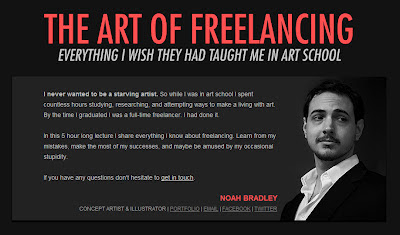
REVIEW: Noah Bradley's The Art of Freelancing

During random  internet exploration of the fabulous critique site, WiPNation, I stumbled across a blog post featuring an article about Noah Bradley's Art of Freelancing.  I was instantly intrigued by the prospect of learning 'what the art schools didn't teach' and decided to give Noah's video a try after seeing a positive review at ArtOrder and listening to the free preview of the first 30 minutes posted on the site.


I was sold in that first 30 minutes with Noah's very up front approach to the hard truths of what freelancing really is.  It is oftentimes hard work, sleepless nights, and low pay, but most importantly one CAN make a living as a freelancer, if one is persistent!  Noah addresses commonly asked questions from novice freelancers, including but not limited to:

- How much do I charge?
- Where do I look for clients?
- What's in a contract?
- Where do I look for work?
- How does a portfolio review work?

There are a lot of questions answered that are useful for both beginners and advanced freelancers as well. Some of the discussions in this video that really impressed me were the more hazy aspects of the industry Noah addressed such as:

- What is the mindset of the Art Director?
- Is there such a thing as starting commissions too early?
- Why aren't you getting work?
- What is a freelancer's financial situation really like?

Many of these advanced discussions really forced me to turn my gaze inwards to my own work and be honest with myself as to where I need to improve and what strategies I need to employ for exactly how I can do so. I've also realized from this video some of the mistakes I have made as a developing freelancer.

For instance, I believe now after viewing this video that I started commissions far too early in my career.  I spent a lot of time making a quick buck over at DeviantART in my junior years when I should have been working hard on pieces I could put in my portfolio.  The internet never forgets your prices and the quality of that 'younger' work and it's taken me some years to get away from my amateur commission pieces, which only served to spread my reputation as someone willing to work for less and produce amateur work.

If I could start over, I would not have started taking personal commissions until my work was more refined so that I could have started at a more respectable level of perceived worth (which would have, in turn, helped me in asking more for my work currently, since I had become so used to asking for so little when I was younger).

But if there's anything to be learned from Noah's video, it's the message of hope that, while it may be challenging, freelancing is not impossible!  Especially not when we have the internet and easily accessible resources to share with one another.  As a plus, Noah's video comes with a link to a resource page where he shares recommended art communities, useful books, and more!  This site is to be constantly updated with new resources suggested by Noah and others, making it a useful collaborative learning tool that I will certainly be contributing to and referring to in the future.

Overall, I highly recommend this video for anyone serious about doing freelance art for a living.  Noah Bradley is a Scifi/Fantasy illustrator and concept artist, so there is a stronger focus on these aspects in the video, but there is something for every freelancer to take away from this video.  It may seem pricey at $57, but consider it an investment in your future career! I did and I am fully satisfied that this video is going to help me get to the places I want to be because it helped to fill so many gaps in my own experience that I didn't even know I had.

Brilliant video, brilliant artist, and brilliant learning tool!  I hope to see others doing more like this in the future to help de-mystify the mysteries of being a Creative Professional.